

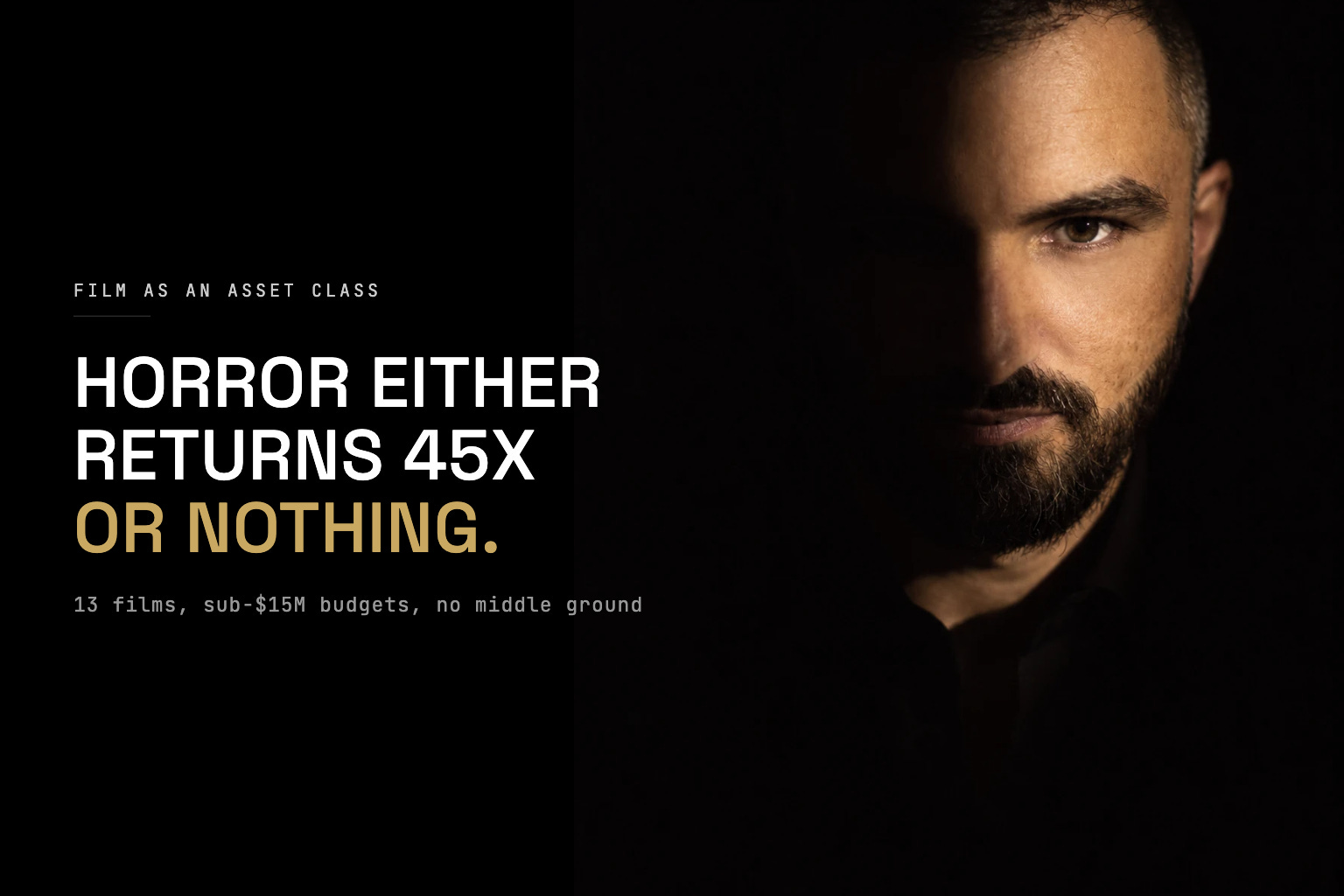
$2M budget. $89.2M global gross. No studio. No franchise IP. No star.
That’s “Terrifier 3”.
Cineverse distributed it on a $500K marketing spend. Total capital deployed: $2.5M. Total gross: $89.2M. That’s over 40x the production budget returned from global box office alone, before streaming and ancillary rights - everything a film earns after theaters: streaming, TV, airlines, merch.
People hear numbers like this and assume lightning-in-a-bottle. That’s the wrong read.
The Terrifier franchise had already proven its audience before the third film. Art the Clown had a following. Cineverse, the distributor, owns Bloody Disgusting and a streaming platform with 80 million subscribers. The marketing wasn’t a gamble into the dark - it was a $500K activation of an audience that already existed. The structure was built before the budget was spent.
This is what genre economics look like when the fundamentals are right.
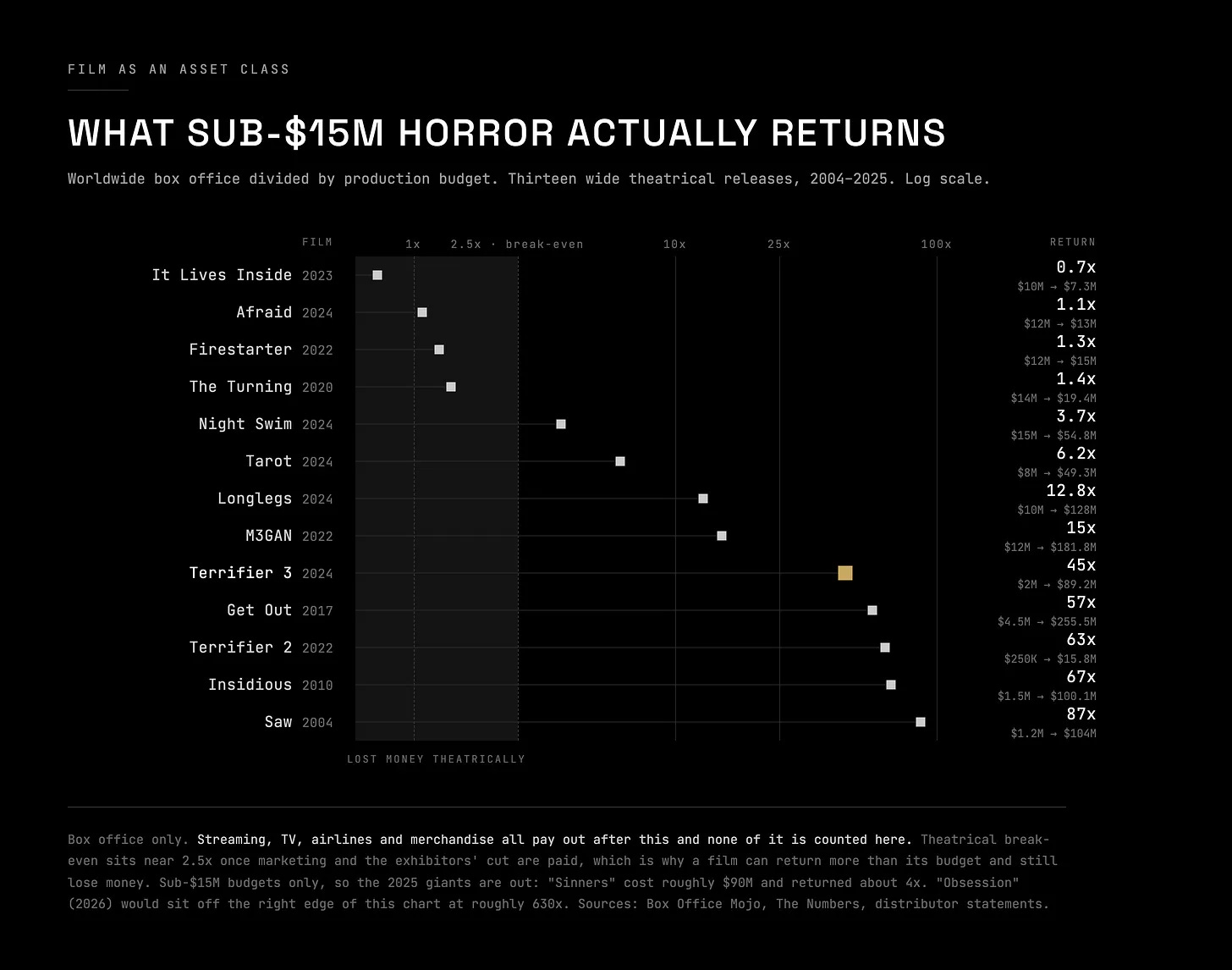
Horror’s $-to-screen ratio is the best in independent film. Take a decade of sub-$15M horror releases and plot what each one returned against what it cost, and the shape is strange. The failures sit around 1x. The winners run 13x, 15x, 45x, 87x. Almost nothing lands in between. Terrifier 3 sits near the top of that spread, not outside it.
Three things made this work.
The budget tier. At $2M, every dollar of gross above breakeven is margin. There’s no $50M overhead to service before investors see anything. The math is simple and honest.
The pre-existing audience. Franchises have cost curves that look like any other platform business - the audience acquisition cost drops dramatically on each subsequent title. By part three, the marketing has one job: remind an audience that already decided.
The distribution match. Cineverse isn’t a random distributor. They built channels specifically for horror audiences. The film landed with a distributor whose infrastructure was designed for exactly this asset. That alignment is rare, and it’s worth checking for in any deal.
Four of the five most profitable films of 2024 were horror. The pattern holds across years, not just one lucky slate.
And 2026 just produced a bigger one. “Obsession” was made for $750K by a YouTube creator on his first feature. No franchise, no prior installment, no clown with a following. It closed its theatrical run this month at $475M worldwide, the seventh biggest horror film in history. The audience
came from 700 million views on the director’s own channel.
Same fundamental, different source. Terrifier built its audience across two films. Barker built his on YouTube. In both cases the structure existed before the budget was spent, and the marketing had one job: remind people who had already decided.
The filmmakers locked their win even earlier, selling worldwide rights to Focus Features for $15M at Toronto, months before release. The $475M is the buyer’s bet paying off. Either way, someone paid for an audience that already existed.
The genre’s audience shows up. They don’t need critics. They don’t need crossover appeal. Horror fans are the one audience that pre-forgives a film for having no stars in it. They need the right film in the right hands at the right budget.
Terrifier 3 and Obsession are the clean cases. Everything went right. Yes, most genre films don’t look like this.
But the underlying logic is the same.