


Canada’s film tax credit is not one number. It’s a stack of moving parts, which is why most people settle for a vague “25 to 40%” and leave it there. That range is real. It’s also what you get if your producer is lazy. Here’s what the credit actually is, and how a disciplined one runs it well past that.
First, it isn’t a discount on your budget. It’s refundable cash, paid by the government, calculated on qualifying labour, not on total cost. Refundable means you get it even if the company owes zero tax.
There are two systems, and you pick one per film. The Canadian-content path (CPTC federally, FIBC in British Columbia) is for Canadian-owned, Canadian-controlled productions. The production-services path (PSTC) is the one Hollywood uses to shoot in Vancouver. Each splits into a federal layer and a provincial layer, and the provincial layer sits on top of the federal one.
For a Canadian indie shot in BC, the relevant stack is CPTC plus FIBC.
The rates, current as of 2026:
Federal CPTC: 25% of qualifying labour, capped at 60% of net cost, so the real effective rate on total budget is around 15%. That’s the federal piece alone, and it’s why a conservative read lowballs the whole thing.
Provincial FIBC: 40% of qualifying BC labour. Then bonuses on top: regional +12.5%, distant location +6%, scriptwriting 35% on pre-production writing by BC-based writers, training 30% of trainee pay, and a DAVE bonus of 16% on visual-effects and post labour.
You cannot add those into one giant percentage though. They apply to different bases, and the provincial credit counts as “assistance” that grinds the federal one down. Model it net, never as a naive sum. But the direction is clear, and it runs well past the headline.
Watch it on a real shape. A $2M Canadian feature. Both credits cap the qualifying labour: FIBC tops out at 60% of the cost of production, so the base maxes at $1.2M no matter how much more you spent on crew. The federal credit has its own 60% cap.
FIBC at 40% on the $1.2M qualifying labour: $480,000.
Federal CPTC, after the provincial grind and the 60% cap: about $230,000.
Total: roughly $710,000 back. About 35% of the whole budget in refundable cash.
And that’s the floor. Basic credits only, no location bonuses, no DAVE, no scriptwriting credit. The producers who treat this as a craft, not a line item, go higher. A few moves do most of the work, and most productions leave them on the table.
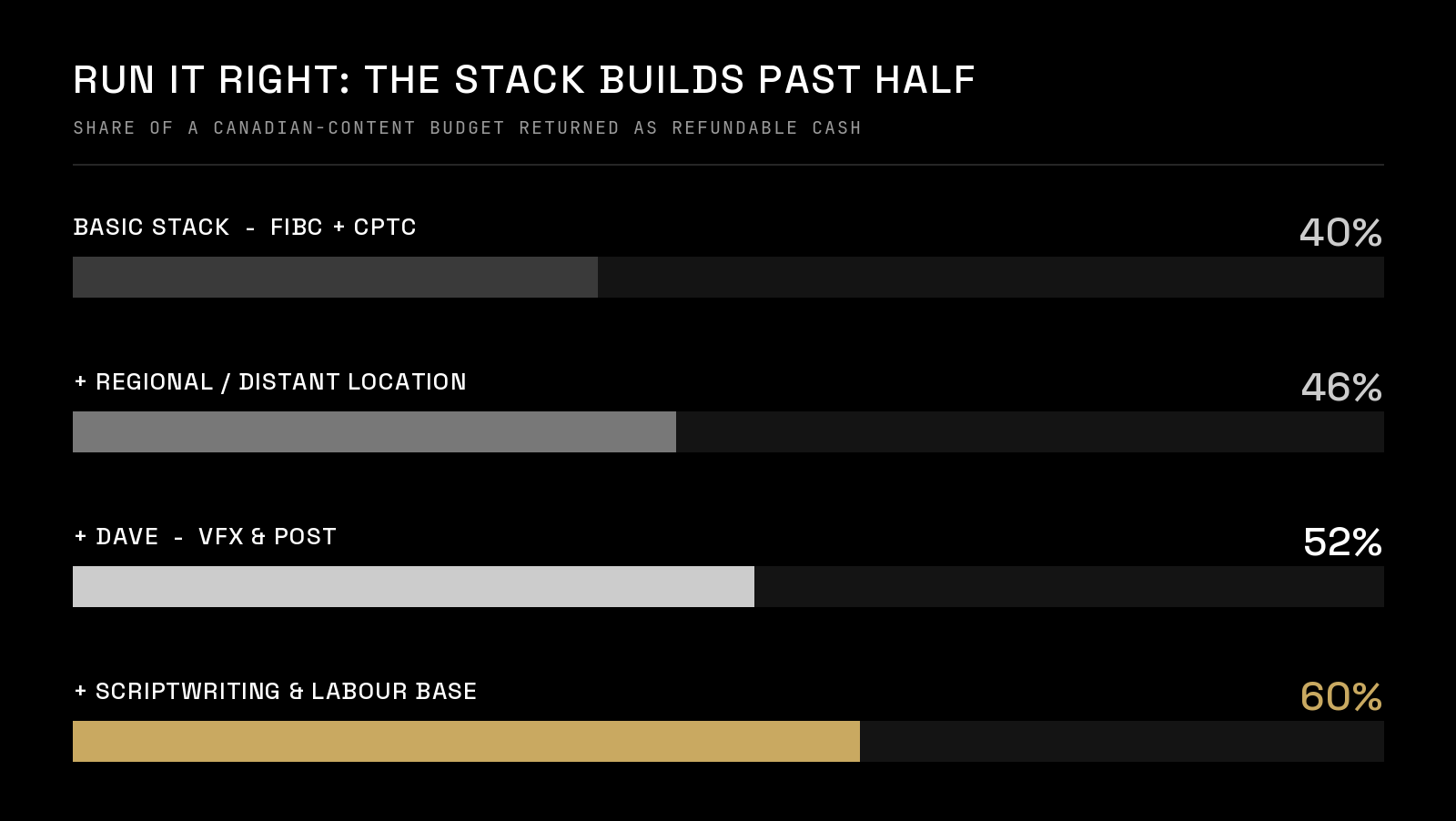
Location. Shoot in a regional or distant area and you add 12.5% and 6% on labour, prorated by how many of your shoot days happen there. That’s a scheduling decision you make while you’re scouting, not a form you file later. Plan the calendar around the bonus.
Most filmmakers never reach for it because they assume distant means expensive. Often it’s the reverse. Vancouver Island, Sunshine Coast, Kelowna: cheaper permits, cheaper housing, less red tape. The remote shoot is the cheaper one more often than the budget in your head says.
VFX documentation. The DAVE bonus pays 16% on visual-effects and post labour, and most producers read that as the post house alone. It also reaches the on-set crew who shot a plate that later gets effects work. The bonus follows the paperwork, not the intention. You only get it if the shot was flagged as VFX-bound on the day. Nobody logging it on set means nobody claims it after wrap, and on a tight indie that’s real money walking out the door.
Vendor labour. A lot of what reads as “rental” has labour buried inside it. The location that comes with a site rep, the equipment house whose invoice includes its BC crew, the grip package that shows up with an operator. That labour portion is claimable, but only if it’s broken out on the invoice. So you do the unglamorous thing and ask every vendor to put the labour share in writing. It costs them nothing, most will, and the producers who can’t be bothered are the ones who later wonder why the credit came in light.
Crew kit. On an indie, half the crew arrives with their own gear, from the sound recordist’s kit to the DP’s lenses. You’re paying for that work either way, and inside a kit or box rental there’s a reasonable labour portion you can carry as labour rather than leaving the whole line sitting as equipment. The discipline is to keep it modest, a sensible slice, not a wholesale reclassification of the rental. A small, defensible amount survives an audit. Greed invites an adjustment.
Stack those and total-budget recovery clears 50%, past $1M on this $2M film. Labour-side recovery runs into the 70 to 80% range. Same film, same statute, a much bigger cheque.
None of this is a trick. It’s reading your own budget the way the statute reads it, and documenting what’s already there. Every one of these moves is inside the rules. The credit rewards the producer who does the paperwork, and quietly shrinks for the one who doesn’t.
There’s a price, and it’s not money. It’s paperwork. Labour codes set up on day one, residency proof collected at onboarding instead of chased after wrap, shot logs, vendor confirmations, the right corporate structure. The bonuses are real. The discipline is what you pay for them.
Why this matters if you’re the one writing the check, not making the film: this is the most de-risked dollar in the entire capital stack. It’s government money, it’s refundable, and banks will lend you up to 90% of it up front against an accountant’s opinion letter. A producer who understands it structures the raise around the gap above the credits, not the full budget. That single move changes how much equity is actually at risk.
The headline number is a ceiling for the lazy and a floor for the disciplined. Run it properly and it covers more than half.
Same statute. Different producer.
This is general information, not tax or legal advice. Rates and caps change; confirm current figures and your eligibility with a film tax-credit accountant.