

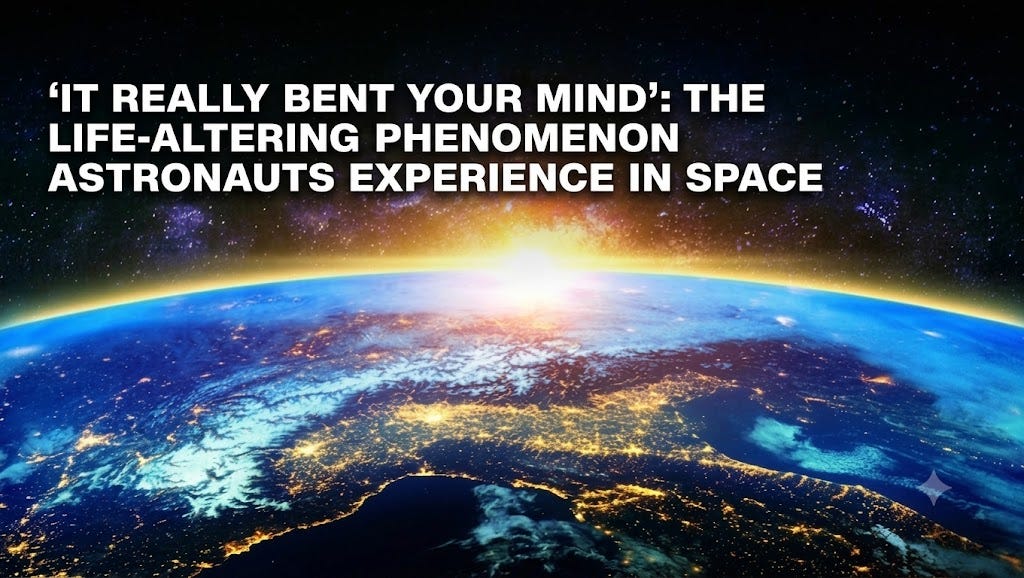
In 1968 the Apollo 8 crew saw Earth from the outside, whole, for the first time in human history.
The photo Bill Anders took that day, “Earthrise”, became one of the most reproduced images of the century. But the more interesting thing happened inside the astronauts. Many came back changed. Borders looked invented. Conflicts looked small. The daily noise lost some of its volume.
Psychologists eventually gave the shift a name: the overview effect - a lasting change in perspective that comes from seeing the whole instead of the fragment. Astronauts keep describing it in almost identical words, decades apart, across countries and missions. Something about the view rearranges the viewer.
You can’t send every viewer to orbit. The ticket economics don’t work.
But a film can do a smaller version of the same thing. Two hours in a dark room, and you walk out seeing your own life from a slightly different altitude. Most films don’t attempt this. The ones that do are the ones people carry around for decades.
That’s my mission in one line: films that entertain, and quietly expand your horizon.
It took me three businesses and two films to arrive at that line. I came to film from a decade of running companies: a tech startup, transport, construction. Business taught me systems and discipline. Film gave the systems something worth carrying.
Every project I greenlight from now on gets filtered through one question: does this expand how the viewer sees their world, or just fill an evening.
A producer with a mission is a better bet than a producer with a spreadsheet. I say that as someone holding both. The spreadsheet matters: my last release went to 40+ countries and investors were repaid, and I build every film on that discipline. But a spreadsheet only describes the plan. It says nothing about what the producer does on the day the plan breaks.
A film takes years from first draft to screen. Over that distance every project hits moments where it would be easier to stop. What carries it through isn’t the spreadsheet. It’s a producer who knows exactly why this film should exist.
“Lookout”, the film I’m financing right now, is the first one built fully on this filter: a contained folk-horror that works as a genre film on the surface and lands as something bigger underneath. Commercial discipline below, perspective shift on top.
Commercial doesn’t mean shallow. That contradiction is my whole business.
The numbers side of this argument - how the discipline works, what the floor looks like, who recoups first - lives on the investor page.