


“Harry Potter and the Order of the Phoenix” grossed nearly $1 billion worldwide.
New Line’s accounting showed a $167 million loss on paper.
Both numbers are real. The distance between them is a mechanism called the waterfall.
The waterfall is the contractual sequence that determines who gets paid, in what order, before a single dollar reaches the equity investor. It is not a conspiracy. It is a legal document. And if you invest in film without understanding it, you will get your first quarterly statement and wonder where your money went.
Here is how it actually works.
A film’s revenue is structured like Shrek’s onion: layer after layer, and by the time you reach the middle, someone’s crying. Every dollar passes through a series of buckets. The top bucket fills first. The next bucket only receives what overflows. Equity investors sit at the bottom - the innermost layer. On a $2M film that earns $1.8M in total revenue, here is what happens before the investor sees anything:
The collection account manager takes 1% off the top. That is $18,000. Guild residuals - ongoing payments owed to the actors’ union, SAG-AFTRA: $25,000. The sales agent takes a 20% commission on gross revenue - roughly $351,000. The sales agent then recoups their expenses, capped at $60,000. Territory distributors take their fees across all the markets where the film sells: $180,000. Prints and advertising - the marketing spend for a limited release: $80,000.
Total off the top: roughly $714,000.
Remaining for equity recoupment: about $1,086,000. The investor is owed $960,000 - their $800K principal at a 120% preferred return, meaning they get their money back plus 20% before anyone splits profits. In this scenario, they recover the full amount, plus roughly $63,000 in profit share. A 28% return.
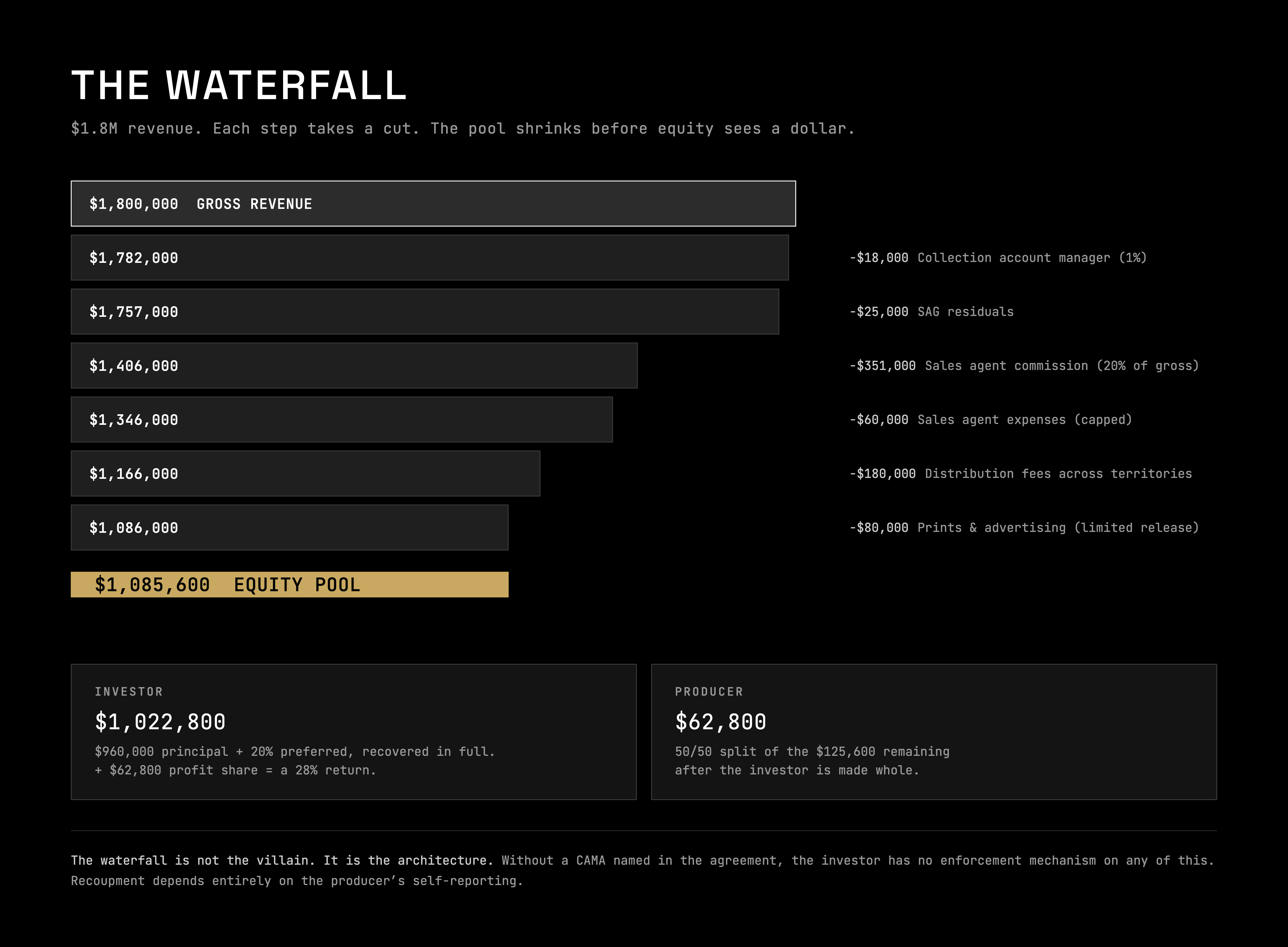
That is the good scenario.
Change the revenue to $800,000 instead of $1.8M - which is closer to the median for a film without solid festival attention and mid-tier international distribution - and the investor recoups about $380,000 of their $800,000. That is a 52% loss, on a film that got distribution.
Now stack the Hollywood Accounting cases on top of that mechanic.
“Forrest Gump” grossed $678M and won Best Picture. Author Winston Groom had a 3% net profit clause. He received $350,000 total. Paramount’s overhead charges, distribution fees, and internal allocations ensured the film never officially reached “net profit.”
Art Buchwald sued Paramount over “Coming to America”, which grossed $288M. A judge called the studio’s accounting practices “unconscionable.” Paramount settled for $900,000 rather than defend its methods in open court.
“The Lord of the Rings” trilogy grossed $6 billion across films and merchandise. Fifteen cast members sued over unpaid merchandise revenue. The Tolkien estate sued over 7.5% of gross receipts owed by contract. New Line’s books showed “horrendous losses.” All cases settled confidentially. The accounting was never defended in public.
These are studio cases. A properly structured independent film is different. The mechanism that changes everything is called a CAMA - a Collection Account Management Agreement. A neutral third party like Fintage House or Freeway Entertainment receives every dollar the film earns, verifies it against the contractual waterfall, and disburses to each party in order. The producer never touches the money. Setup cost: roughly $8,000. Ongoing fee: 1% of gross through the account. On a $2M revenue film, that is $20,000 total. It is the $20,000 that sits between “I trust the producer will pay me” and “a financial referee holds the funds.”
Without a CAMA, you are waiting for the producer to voluntarily send you money from their own bank account, against their own expenses, with no independent verification of what came in.
The waterfall itself is neutral architecture. Whether it protects you or works against you depends entirely on whether you read it before you sign.
Four things every investor should have in writing before closing: the full recoupment schedule with every position defined, a CAMA named in the agreement, an expense cap on the sales agent, and an explicit definition of what counts as a deductible cost before net profits are calculated.
Film earns money every week. The question is which bucket you are sitting in.
Reading the bucket right is half the work. The other half is recognizing the deals that won’t ever pay out, no matter what the waterfall says.