

I can make the case that 2026 is the best year in roughly a decade for an investor to put money into an independent film.
Most investors who hear that assume I’m pitching them. Not really. I’m pointing at five structural things that happen to be converging right now.
Here’s the framework.
1. Supply is still 23% below peak, and the streamers raised their budgets anyway
The 2023 writers’ and actors’ strikes were the largest production shutdown since COVID. That gap never closed. Scripted television production is still about 23% below its 2022 peak. The US share of global production fell from 52% in 2022 to 38% today. Los Angeles just logged its lowest shoot-day count on record outside the 2020 shutdown.
One category is growing through all of this: independent features, up 19% year over year, almost all of it in films budgeted under $40M.
The demand side didn’t wait for supply to recover. Netflix spent $18B on content in 2025, its highest ever, and guided $20B for 2026. Subscribers passed 325M. Streamers as a group just overtook broadcasters as the largest content buyers in the world. Their collective response to a supply shortage was to raise the budgets. Subtle.
Demand up, supply compressed, and the one growing supply segment is exactly the budget range where independent film lives. This is the least discussed advantage in indie film finance right now. It doesn’t live in a pitch deck. It’s in the ProdPro data.
2. California went refundable and more than doubled the program to $750M
For decades, California’s tax credit was useful only if you owed California state tax. Most out-of-state investors and production companies didn’t. That changed in summer 2025, in two moves: AB 132 raised the annual allocation from $330M to $750M, and AB 1138 rebuilt the program itself. Base rate 35%, up to 40% for qualifying spend, and, for the first time, refundable: the state pays cash even if you owe no California tax. The refund route pays 90% of the credit’s value over five years. Still cash, still government-backed, just not a lump sum.
That’s a structural change, not an incremental one. Productions that couldn’t realistically model California credits before can model them now.
3. The soft-money layer has never been this generous, on either side of the Atlantic
Soft money is the part of the budget that doesn’t come from investors: tax credits, incentives, rebates. Two jurisdictions currently lead, and comparing them is where most people get it wrong.
The UK’s Independent Film Tax Credit went live in April 2025. The headline rate is 53% of qualifying spend; after the tax charged on the credit itself, the net cash back is about 39.75%. On a £5M indie film with 80% UK spend, that’s roughly £1.59M back from HMRC - the British tax office, an institution not historically famous for generosity - before the film makes a single pound of revenue. Films qualify up to £15M in core spend, which is exactly where serious indie dramas and genre films are made.
British Columbia usually gets quoted at 52%: the 36% provincial production services credit plus the 16% federal one. That’s the lazy read, for two reasons pulling in opposite directions.
First, the base. The UK counts nearly all production spend; BC counts labor only. A 52% labor credit is not a 52% budget credit.
Second, the stack. 52% is the floor, not the ceiling. Regional and distant-location bonuses go on top when you shoot outside Vancouver. Visual-effects and post labor earns another 16%. Run the full stack with discipline and total-budget recovery on a BC indie clears 35% at the floor and passes 50% for the producer who does the paperwork. Converted to the same base, a well-run BC production beats the UK’s net 39.75%. The headline number is a ceiling for the lazy and a floor for the disciplined.
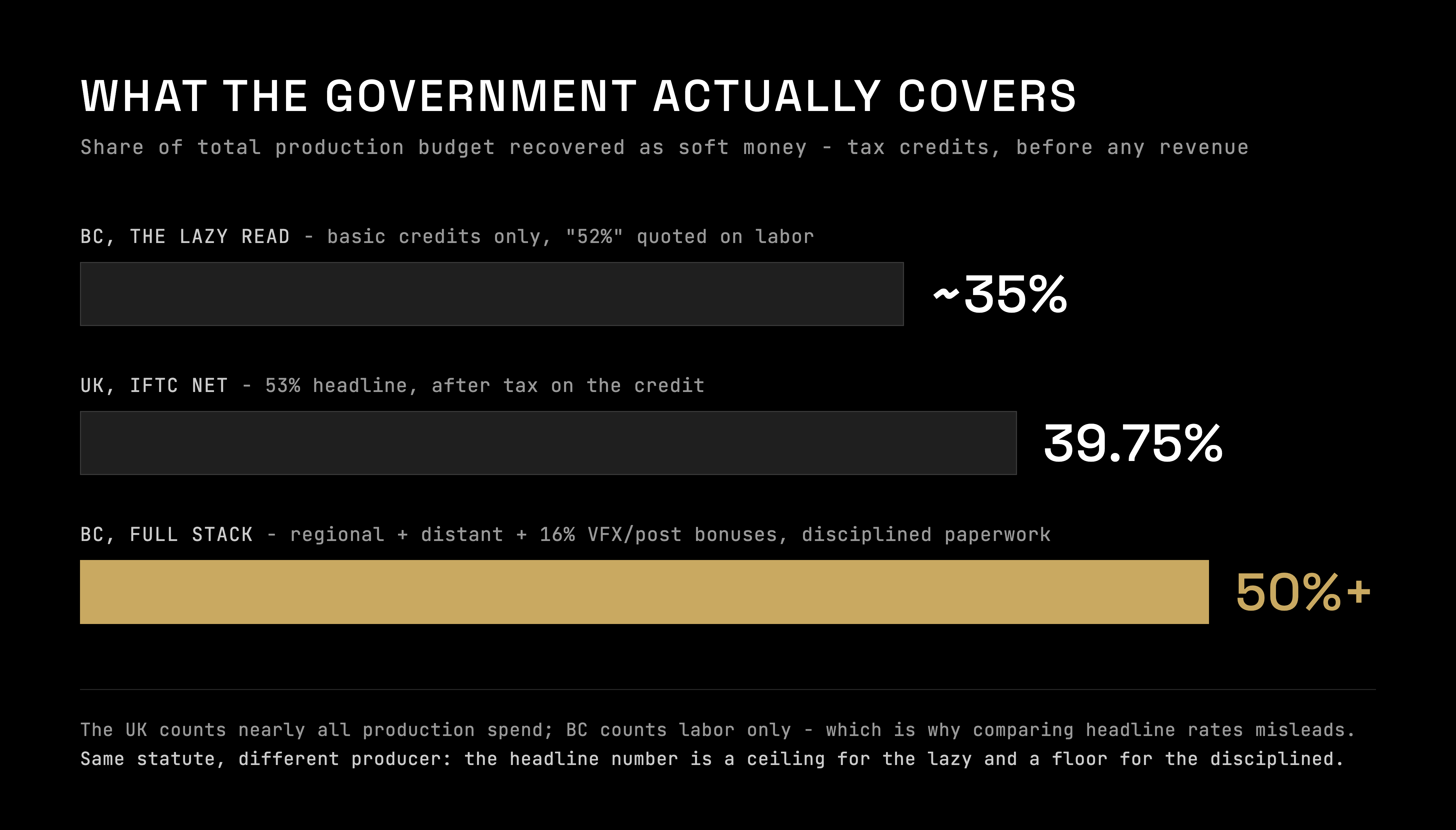
When you hear a producer say “soft money covers 30-50% of my budget before we’ve sold anything,” this is where that number comes from. And the government takes no equity for it. They pay a fixed incentive and exit. The upside stays with the private capital.
4. Buyers are paying real money again, for the right titles
At Sundance 2025, Neon paid $17M for worldwide rights to “Together,” a body-horror film with Dave Franco and Alison Brie, outbidding A24 and Netflix. One of the richest deals in the festival’s history. The film went on to $34.5M worldwide.
I won’t pretend that’s the median. Most festival acquisitions still gross $1-3M. This is a hits business: the right title with the right positioning gets a bidding war, the rest get quiet deals. Anyone selling you an “average Sundance multiple” is selling you something.
The part most investors miss is what happens after the sale. In November 2025, Alcon paid $417.5M for Village Roadshow’s 108-title library - the “Matrix” trilogy, “Joker,” “Mad Max: Fury Road” - outbidding a $365M rival offer, for a catalog generating roughly $50M a year. In the UK, back-catalogue sales just reached 44% of all TV export revenue, up 4 points in a year, because budget-squeezed buyers lean on proven titles. What looks like a one-time sale at acquisition is actually the opening entry in an asset that licenses, relicenses, and appreciates.
5. ESG disillusionment is opening institutional appetite for cultural creation
US sustainable funds have now posted 13 consecutive quarters of net outflows. 2025 was the worst year on record: $21B pulled, the third straight annual outflow. 91 US sustainable funds were liquidated or merged in 2025, against 9 launches. BlackRock, which publicly championed ESG, supported under 2% of the environmental and social shareholder proposals it voted on in 2025, down from over 40% in 2021.
ESG - the environmental-social-governance investing category - is a negative filter on existing companies. It doesn’t create anything. Film is the opposite: direct creation of cultural IP that reaches audiences at scale. “An Inconvenient Truth” cost $1.5M to produce and did nearly $50M at the worldwide box office, before DVD, broadcast, and two decades of classroom screenings. No ESG fund produced a cultural artifact with comparable reach.
Family offices, impact funds, and ex-tech founders who have cycled through the ESG conversation are increasingly asking what they can actually build with capital. Film is a credible answer to that question, with a financial structure that can support it.
Five things at once. That’s the setup.
Post-strike supply compression. California refundable at $750M. The UK at 53%. BC stacking past it for the disciplined. Buyers paying eight figures for the right premiere. Institutional capital walking out of ESG with nowhere obvious to build.
Let me be precise about what’s temporary here and what isn’t. The tax credits are statutes. They don’t expire next quarter, and nobody should build a film investment thesis on a countdown clock. What is temporary is the supply gap - production will recover - and the buyer competition that comes with it. The credits will still be there in 2028. The leverage of entering while supply is short won’t.
The producers who understand this are already structuring projects around it.
I’ve spent years building into this industry. The slate I’m working on is designed specifically around this structure: soft money first, investor risk reduced before the camera rolls, distribution path defined before greenlight.
If your alt-asset bucket is open and cinema is on the list, 2026 is a very good year to look closely.